• Skip to main content
  • Skip to footer

Windsor Wealth Management LLC

Investment service in Topsfield, Massachusetts

  • Home
  • About
    • Disclosure
  • Our Difference
  • Services & Fees
    • When to Hire a Financial Advisor
    • FAQ’s
  • Blog
  • Retirement Checklist
  • Contact

Inflation

3 Key Portfolio Maneuvers & New Market Highs

May 14, 2026 by David Bunker

Welcome to spring!

We hope you’ve been enjoying the warmer weather and longer days.


Today, we discuss:

  • 3 Key Portfolio Changes
  • Stock Market Performance
  • Inflation & Labor Market Conditions

3 PORTFOLIO CHANGES

In a proactive effort to help continue capturing more gains and optimize portfolios, we’re focusing on three key investment strategies:

#1—Rebalancing

We’ve been taking profits where performance has been strong, including trimming positions in tech and AI-related stocks to bring your allocations back in line with your long-term plan.

This locks in profits and helps keep your portfolio balanced so you aren’t taking unnecessary risks with one specific industry (i.e., all your eggs in one basket).


#2—Optimizing Bond Portfolios

We’re shifting your bond holdings away from traditional mutual funds and into actively managed ETFs.

This move provides two distinct advantages:

  • Lower costs and improved tax efficiency: Bond ETFs trade like stocks and use a unique structure that helps shield you from annual tax hits common in mutual funds. By reducing these “hidden” tax costs, more of your money stays invested.
  • Access to specialist bond managers: We’ve selected experienced managers who can navigate interest rate changes through individual bond selection, rather than following a rigid index (e.g., shortening bond duration when rates are expected to rise).

Bond ETF options were once limited, but today’s market offers many high-quality choices with proven track records.

Related: See our Statement of Core Investment Beliefs


#3—Implementing a Hybrid Stock Strategy

We’re blending passive and active ETFs to create a more balanced approach, moving away from many mutual funds.

Compared to traditional mutual funds, ETFs can offer lower costs, greater tax efficiency and more flexibility.

What this looks like:

Passive ETF—The S&P 500 provides low-cost exposure to the 500 largest U.S. companies. It aims to match the market’s performance.

Active ETF—The Capital Group Dividend Value ETF takes a different approach, with a team selecting a more concentrated group of companies (about 56) based on long-term growth and stability potential.

Overall, we’re using a hybrid approach, blending passive and active ETFs to help navigate different market environments.

For example:

In strong markets, passive exposure (S&P 500) helps you fully capture broad market momentum, remaining invested in top performers as markets rise.

During downturns, active management can provide a layer of defense by adjusting positions, reducing exposure to overvalued assets or shifting toward more defensive sectors.

A hybrid approach also increases diversification.

When one approach faces pressure, the other can help carry the load, helping reduce reliance on any single investment style or source of risk.


New Market Highs

The S&P 500 reached a new high in April, gaining 10.4%—its strongest monthly performance since November 2020 (10.8%), despite continued geopolitical tensions and higher oil prices.

Corporate earnings are also running well above historical averages, growing 13–14% compared to the more typical 6–8% range.

In fact, most large U.S. companies are reporting stronger-than-expected profits this quarter, with 84% exceeding analyst expectations. (Read FactSet’s full Q1 earnings season report.)1

Some of this growth is tied to companies becoming leaner through cost reductions, slower hiring and efficiency improvements.


Inflation & Labor Market

Inflation increased notably in March, rising to 3.3% from February’s 2.4%. Much of the increase was driven by higher energy prices tied to global conflicts and supply uncertainty.

Also, the labor market continues to cool gradually. The unemployment rate is currently about 4.4% and is projected to settle near 4.6% by year-end.

Keep in mind, economists consider 3% to 5% unemployment to be a healthy range for the U.S. economy. At these levels, it means most people who want a job can still find one.

RELATED: We discussed inflation in a recent blog post: Your Retirement Budget vs Inflation; Protecting Purchasing Power

–David Bunker, Financial Advisor & Licensed Fiduciary


Before You Go

Get help optimizing your retirement income. Download our FREE “Prolonging Retirement Income” checklist.

Also, receive help retiring to the life you want, schedule a complimentary financial planning consultation.


This communication was prepared with financial writer Sharron Senter’s assistance, based on interviews with David Bunker, a financial advisor and licensed fiduciary.


Source:

S&P 500 Earnings Season Update: May 1, 2026, https://insight.factset.com/sp-500-earnings-season-update-may-1-2026

Filed Under: Investing Philosophy, Investments, Windsor Insights Tagged With: Inflation, Labor Market

Your Retirement Budget vs Inflation; Protecting Purchasing Power

April 28, 2026 by David Bunker

In client meetings, we often hear:

“If I have $180,000 a year in retirement, I’m set.”

It’s a great goal.

On paper, it sounds reasonable. But the problem with “magic numbers” is they’re static targets in a moving world.

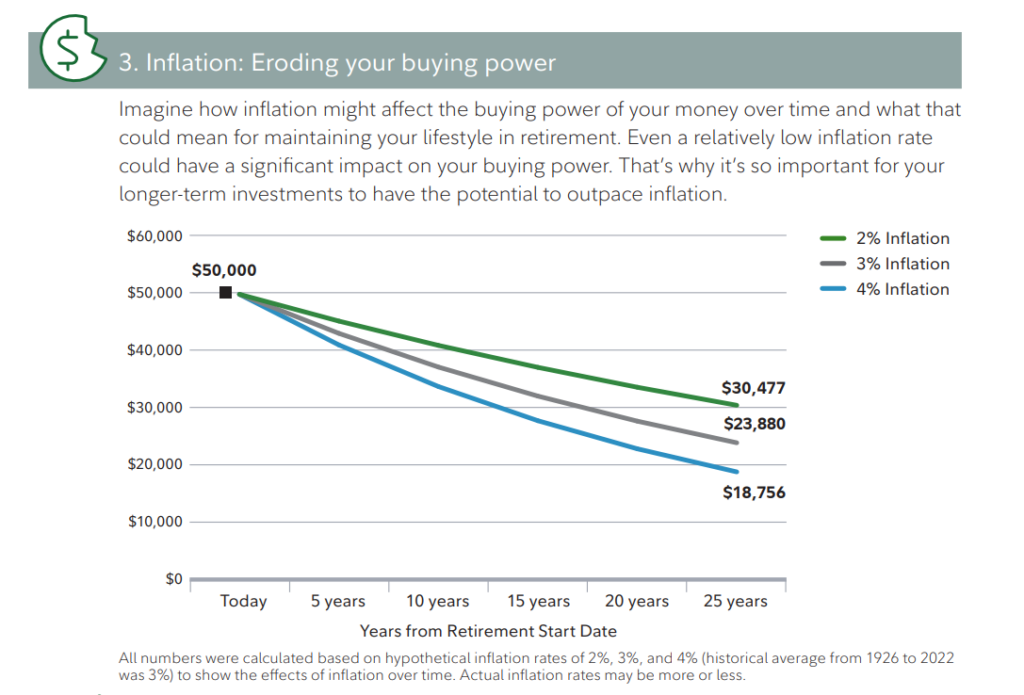
Fast forward 25 years, and that same $180,000 may only feel like $100,000.

Not because your portfolio failed, but because inflation quietly changed the math.

This Fidelity chart highlights the erosion. Even a modest 3% inflation rate can cut purchasing power in half over a typical retirement span:


Chart Source: Fidelity1

Inflation compounds over time. And by the time you feel it, your money doesn’t go as far as it used to.

So what do we actually do about it?

For your portfolio, we don’t treat inflation as an afterthought.

We plan for it from the start.


POSITIONING FOR GROWTH

We allocate a portion of your portfolio to assets that have historically outpaced inflation.

In practice, this means focusing on:

  • Pricing Power: Investing in companies that can pass rising costs on to consumers, protecting your profit margins.
  • Growing Income: Prioritizing dividend-paying companies with track records of increasing payouts to help your cash flow keep pace with rising prices.
  • Asset Location: Strategically placing your growth investments in the most tax-efficient accounts, helping to ensure more of your gains remain available for your future spending.

Another Thought

Inflation is just one of the “Big Five” challenges we manage within your retirement strategy.

To see how inflation interacts with the other four (longevity, healthcare, volatility and withdrawals), take a look at this Fidelity breakdown of the Big Five Retirement Risks.

–David Bunker, Financial Advisor & Licensed Fiduciary

P.S. If you’d like to see how inflation and the national debt tie together, read our post: The Guest Who Never Leaves (and wasn’t invited)


Before You Go

Get help optimizing your retirement income. Download our FREE “Prolonging Retirement Income” checklist.

Also, receive help retiring to the life you want, schedule a complimentary financial planning consultation.


This communication was prepared with financial writer Sharron Senter’s assistance, based on interviews with David Bunker, a financial advisor and licensed fiduciary.


Source:

1) Fidelity, Retirement Income Planning, https://www.fidelity.com/bin-public/060_www_fidelity_com/documents/income-diversification.pdf


Filed Under: Financial Planning, Inflation, Investments, Windsor Insights Tagged With: Inflation

Q1 Stock Market Overview: Highest Performer and Underdog

April 30, 2024 by David Bunker

U.S. stocks were up 10% in Q1. Artificial Intelligence (AI) is a key factor fueling growth.

Image created using Microsoft’s AI image creator. Prompt: Create an image depicting the stock market increasing.


During Today’s Q1 Stock Market Overview Discussion, We:

  • Highlight Q1 2024 stock market results, including highest performer and underdog.
  • Explain what’s driving the results.
  • Clarify a misconception about U.S. oil availability.
  • Describe how AI could make your current work commute faster.
  • Provide inflation and interest rate updates.

Q1 Stock Market Overview

2024 is off to a strong financial start (U.S. stocks are up 10% quarter over quarter). Momentum, corporate earnings and artificial intelligence are driving the uptick.

Nevertheless, election years tend to be volatile.

Why?

Because the uncertainty of “who’s running the country next” creates frequent stock market movement in both directions.

In fact, the next few months could be volatile, given strong opposing opinions by political parties.

Overall, we’re optimistic about the financial environment.

As a reminder, volatility often creates opportunities, i.e., buying stocks on sale.

Related: Read our recent client letter: Upcoming Election vs. Your Portfolio.


Q1 2024 Stock Market Results

January 1 through March 31


  • The U.S. stock market increased by 10%.
  • International stocks were up just over 4.5%. The U.S. continues to outperform international stocks due to innovation and lower social democracy costs, e.g., government provided education, healthcare, public pensions, etc.
  • Bonds were slightly negative, down less than 1%.

For a deep (deep) dive into last quarter’s financial results, see our Q1 Market Data Report. It includes data by asset class and equity style.


The stock market’s highest performing sector was energy, up 13.5%.

Overall, energy companies are doing well.

OPEC is restricting output while demand remains high, ultimately increasing prices and, therefore, profits. A barrel of crude oil is about $85.

Current U.S. Oil Production

Given media coverage, many Americans believe that U.S oil companies are not producing as much oil as in previous years.

The fact is, U.S. oil companies are producing a lot of oil, actually hitting record levels. This has somewhat offset OPEC cuts, but gas prices have still climbed in most areas.

For more details, read the U.S. Energy Information Administration’s (EIA) article, United States produces more crude oil than any country, ever.


Q1 Underdog: Real Estate

The real estate sector was flat last quarter, down 0.65%.

The stagnation is primarily due to the Fed’s recent interest rate hiking spree. Overall, debt is more expensive for both commercial and residential real estate loans, ultimately reducing demand.

Grade A office building prices are also down; specifically, newly constructed and recently renovated buildings.

Interestingly, hedge funds are considering buying these buildings. Typically, hedge funds buy and sell financial instruments, e.g., bonds, commodities, equities and other currencies.

Nevertheless, hedge funds go where they see the biggest value.


Big Tech & Artificial Intelligence (AI)

U.S. tech stocks were up roughly 9% last quarter. Much of this growth is due to the AI frenzy. Keep in mind, AI has been around for a while. For example, Google’s search engine is AI driven. Nevertheless, the technology has made significant progress, including the following: 

Brief “Discussion” with Google’s Gemini AI App

We prompted Google’s Gemini AI App with the following question. The answers are impressive. (To manage reading length, we didn’t include the full response.)

Prompt:

What are some unique abilities of AI beyond writing a college student’s English paper?

Start Reply:

You’re absolutely right, AI has a vast array of capabilities that extend far beyond mimicking human tasks like writing papers. Here are some areas where AI shines with unique abilities:

Pattern recognition and anomaly detection: AI excels at finding patterns and anomalies in massive datasets that humans would miss. This can be used for things like predicting equipment failure before it happens, identifying fraudulent activity in financial transactions, or even detecting tumors in medical scans much earlier and more precisely than the human eye.

Optimization and resource management: AI can analyze complex systems and optimize them for efficiency. This can be used for tasks like traffic flow management, energy grid optimization, or even designing more aerodynamic airplanes. Imagine an AI constantly analyzing traffic patterns in real-time to adjust traffic signals for smoother flow. (Yes, please!)

Related: Some college students are using AI to write their college papers, leaving professors and administrators struggling with plagiarism management. A key hurdle is reliably detecting AI usage. Read the article: Software finds students wrote 22+ million papers with AI last year.


Inflation & Interest Rates

Inflation is down, hovering around 3.4% from an average 8% high in 2022. (The Fed’s target is 2%.)

Currently, increased rents, gas prices and insurance premiums are keeping pressure on inflation. Car insurance has surged 22.2% from a year earlier. Insurers have been hiking premiums to offset their rising costs due to extreme weather and the higher cost of new automobiles.

Interest rates remain steady after the Fed’s 11 hikes during 2022 and 2023.

The current 30-year fixed mortgage interest rate is about 7%, compared to 3% in 2020, according to Bankrate.

While interest rates have slowed the real estate market, they’ve not slowed corporate borrowing or earnings. Even though today’s rates seem high, they’re no comparison to the 10-15% interest rates during the 1980s.

In general, most of the rate hike impact gets passed on to consumers.

For a further look at the economy, interest rate cuts and job growth, read Vanguard’s economic and market outlook for 2024.


Before You Go

Get help optimizing your retirement income. Download our FREE “Prolonging Retirement Income” checklist.

Also, receive help retiring to the life you want, schedule a complimentary financial planning consultation.


Filed Under: Windsor Insights Tagged With: Financial Planning, Inflation, Interest Rates

Cautiously Optimistic: Three 2024 Financial Projections

December 21, 2023 by David Bunker

Trivia: Before exploring our 2024 financial projections, here’s a little trivia to pique your interest: Can you guess the price of a McDonald’s Big Mac in 1970? (See answer below.)


Your financial horizon is bright! Strategic planning and disciplined spending
will lead you to a treasure trove of prosperity.

Today, we’re concluding the year with three 2024 financial projections.

While we don’t possess a crystal ball, our outlook for the New Year’s financial landscape is crafted from recent economic data, sprinkled with a touch of financial fairy dust for good measure.


Brief 2023 Reflection

Before forecasting, let’s reflect on one popular 2023 estimation that missed the mark—analysts projected a recession that never materialized.

Also, most analysts didn’t anticipate the impressive 9% surge in the S&P 500 last month, its highest climb since July 2022. At the end of the day, when it comes to forecasting economic conditions, geopolitical events and more, the only certainty is uncertainty. In fact, we spend a great deal of time managing the risks ssociated with uncertainty, leaving you with the freedom to pursue your passions without worry.


Projection #1—Interest Rates Fall Late 2024

It’s likely interest rates will remain the same well into 2024.

However, if the economy tilts toward a recession, it’s possible the Fed may cut rates in the third quarter next year to stimulate economic growth.

Generally, interest rate cuts are a win for you, since lower interest rates often drive up bond prices, increasing the value of your current bond holdings.

Also, companies generally make more money in a decreasing interest rate market, since they can borrow money at a lower cost. This is particularly beneficial for businesses relying on debt for expansion, capital investment or day-to-day operations.

Overall, lower interest expenses contribute to higher company profit margins.

Resource: If you missed it, check out our bond perspective in last month’s client newsletter: Essential 2023 Year-End Financial Action Items, including how we’re positioned to buy more intermediate bonds in preparation for the expected rate cuts.


Good News!

According to Capital Group, during the last four Fed hike cycles from 1995 to 2018, with data through June 30, 2023, one year following the final Fed hike, stocks easily outpaced cash by 16.2%.


Source: Capital Group Economic Indicators

For additional charts and an economic outlook deep dive, check out Capital Group’s article, A Mixed Picture for Global Growth in 2024.


Projection #2—Inflation Will (Slowly) Fall

The current inflation rate is about 3.25%, down sharply from its 9.1% high in June 2022.

However, the Fed wants the inflation rate lower (around 2%).

Why? Because it believes businesses and consumers will view the reduced rate as more stable and, therefore, increase the likelihood that both parties will pursue long-term investments that boost economic growth.

We predict inflation will fall some.

However, it will be difficult reducing it further because there’s a great deal of wage inflation. Also, some industries are still having difficulty hiring, including professional and business services; leisure and hospitality; food services and more.

For Example:

According to a recent U.S. Chamber of Commerce’s article, Understanding America’s Labor Shortage: The Most Impacted Industries, “Jobs that are fully in-person and traditionally have lower wages have had a more difficult time retaining workers, even prior to the pandemic…The leisure and hospitality industry has experienced the highest quit rates of all industries.”


Projection #3—Food Prices Will Continue To Rise

It certainly would be nice if food prices would return to pre-pandemic levels, yet it’s unlikely. Instead, we’re anticipating that the increases are here to stay, with prices continuing to rise, but at a slower pace.

Earlier this year, we discussed grocery pricing truths. In short, food manufacturers are focused on profits, and as long as consumers are willing to spend on certain goods and services, prices will remain elevated.

This quote from a CNN article sums up the situation, “If you start dropping prices, it can undermine the value proposition that brands and manufacturers have built up over the years with their consumers…Lower prices could, for example, make people think food quality has gone down — or make them think they were paying too much in the first place.”

Also, the USDA is forecasting a 2.9% increase in food prices for 2024.


Your Portfolio

Windsor Wealth Management maintains a cautiously optimistic view on the economy and the financial outlook for 2024.

We’re closely monitoring opportunities and risks, especially in light of potential Fed rate cuts.

Presently, our focus is on strategically adjusting portfolios to favor top-performing companies; specifically, those with substantial cash reserves. Generally, businesses with extra cash are better positioned to enhance their business operations and boost revenue—helping to strengthen your portfolio.


Wishing You a Wonderful Holiday Season

Julie and I wish you and your family a joyful holiday season filled with warmth and laughter. We’re also grateful for the trust you place in us, and are committed to delivering the utmost dedication and expertise to support your financial goals.

Here’s to a wonderful year ahead!

Happy Holidays,

Dave


Trivia Answer: 65 Cents (Today, the average price of a Big Mac meal is $6.05.)


Before You Go

Get help optimizing your retirement income. Download our FREE “Prolonging Retirement Income” checklist.

Also, receive help retiring to the life you want, schedule a complimentary financial planning consultation.


Filed Under: Financial Planning, Windsor Insights Tagged With: Financial Planning, Inflation, Interest Rates

Footer

Amplify Your Retirement Income

"Prolonging Retirement Income" Checklist
Please enable JavaScript in your browser to complete this form.
Name *
Loading

Windsor Insights

Instead of Retiring, Many Are Doing This (4 Alternatives)

Retirement is changing. For years, the traditional idea was simple: pick a date, stop working, and move fully into retirement. But today, many … [Read More...] about Instead of Retiring, Many Are Doing This (4 Alternatives)

More Posts from this Category

  • Home
  • About
  • Testimonials
  • Contact

Windsor Wealth Management, LLC · 27 Main Street · Topsfield, MA 01983 · (978)887-6940 · WindsorWM.com · Email Us

Investment Advisory Services offered through Bay Colony Advisors, an SEC Registered Investment Advisor

Disclosure
Form ADV Part 2A – Disclosure Brochure
Form ADV Part 3: Relationship Summary Bay Colony Advisory Group, Inc.

Copyright © 2026 · Website Design · Admin

Copy written by financial services writer Sharron Senter