• Skip to main content
  • Skip to footer

Windsor Wealth Management LLC

Investment service in Topsfield, Massachusetts

  • Home
  • About
    • Disclosure
  • Our Difference
  • Services & Fees
    • When to Hire a Financial Advisor
    • FAQ’s
  • Blog
  • Retirement Checklist
  • Contact

Investing Philosophy

A Key Trend Worth Watching & Your Portfolio

December 29, 2025 by David Bunker

There’s been no shortage of noise lately about an “AI bubble.”

Yet, the data suggests we’re seeing a structural shift in how the economy operates—driven by steady, long-term investments rather than speculation.

As the chart below shows, technology and R&D spending as a share of the U.S. economy is now higher than it was during the dot-com era, currently led by massive investments in AI infrastructure.

However, unlike the 90s, today’s tech leaders are backed by robust earnings and significant cash reserves—capital that’s available for acquisitions, stock buybacks and weathering downturns without needing to raise outside funding.


Chart Source: Capital Group1

Who will win? A key trend to watch.

All this spending begs the question: how does this build-out translate into shareholder returns?

While current winners include the companies building data centers and power grids that supply the computing power AI requires, history suggests the biggest beneficiaries may not even exist yet.

Just as the internet reaching critical mass enabled companies like Facebook (Meta) and PayPal, today’s AI infrastructure build-out is setting the stage for a new generation of high-growth businesses.

So who will they be?

That’s the key question—and only time will tell.

In the meantime, we’re focused on data and research—tracking where investment, earnings and innovation are converging.

You can read more about this concept and the data behind it in Capital Group’s article, 4 charts on why the U.S. economy could stay resilient.2


Your Portfolio: Rebalancing Is Critical During Aggressive Growth

One of our core disciplines during periods of strong growth is frequent rebalancing.

Specifically, trimming positions and taking profits when portfolios drift out of alignment, rather than chasing what’s already run up.

As always, our focus remains the same: staying invested, staying balanced and keeping your long-term plan on track—regardless of the headlines.


Final Thought

It’s important to remember that roughly $7.5 trillion is sitting in money market funds and cash equivalents waiting to be invested.

This sidelined capital adds a significant layer of economic stability, especially during times of loud “AI bubble” noise.

If you’d like to talk through how this trend fits into your portfolio, reach out anytime.

Happy Holidays,

–David Bunker, Financial Advisor & Licensed Fiduciary


P.S. — I recently spent some time analyzing the year ahead. If you’re curious about what’s coming next, you can find my breakdown here: Rate Cuts, Jobs and Growth: A Look at 2026.


Before You Go

Get help optimizing your retirement income. Download our FREE “Prolonging Retirement Income” checklist.

Also, receive help retiring to the life you want, schedule a complimentary financial planning consultation.


This communication was prepared with financial writer Sharron Senter’s assistance, based on interviews with David Bunker, a financial advisor and licensed fiduciary.


Source:

1 & 2: Capital Group, 4 charts on why the U.S. economy could stay resilient, https://www.capitalgroup.com/ria/insights/articles/4-charts-us-economy-resilient.html


Filed Under: Economy, Investing Philosophy, Investments, Windsor Insights, Windsor Money Minute Tagged With: Financial Planning

Is market news scaring you? Here’s the bigger picture.

April 25, 2025 by David Bunker

Could the financial news headlines be more daunting?

Trade uncertainty and its economic ripple effects are behind most of these headlines. (Read our post for the “real” impact of tariffs.)

However, a crucial point often absent in media coverage is the historical link between market volatility and long-term portfolio growth.

For Example:

The below chart depicts the growth of one dollar from 1926 till 2024. The red lines highlight 20%+ market drops.

As you’ll see, time after time the market bounces back—even higher.


Your Financial Plan

We’ve built your financial plan to navigate market volatility.

Candidly, if you want long-term portfolio growth, then the price you pay is short-term volatility.

Unsurprisingly, we’ve seen this recent volatility before, i.e., during Covid. And, we bounced back from that—even higher!

Uncertainty drives volatility.


No one knows when the volatility will end. Nevertheless, we’re confidently buying valuable companies on sale.

I encourage you to stay the course and maintain your financial plan.

Reach out with any concerns or questions.

–David Bunker, Financial Advisor & Licensed Fiduciary


P.S. Thank you to everyone who requested a copy of Bill Perkins’ “Die With Zero.” I was thrilled by the response following last month’s email, How To Spend Confidently & Without Regret in Retirement, where we discussed the book. I still have a few copies available, so please let me know if you’d like one.


Before You Go

Get help optimizing your retirement income. Download our FREE “Prolonging Retirement Income” checklist.

Also, receive help retiring to the life you want, schedule a complimentary financial planning consultation.


This communication was prepared with financial writer Sharron Senter’s assistance, based on interviews with David Bunker, a financial advisor and licensed fiduciary.


Filed Under: Economy, Investing Philosophy, Investments, Stock Market, Windsor Insights, Windsor Money Minute

Our Response to Recent Market Volatility

March 17, 2025 by David Bunker

The stock market’s recent volatility can feel unsettling, but we remain confident in our strategy.

That said, it’s natural to feel rattled—or even tempted to move to cash—when markets drop, especially with the media constantly promoting this approach during market swings.

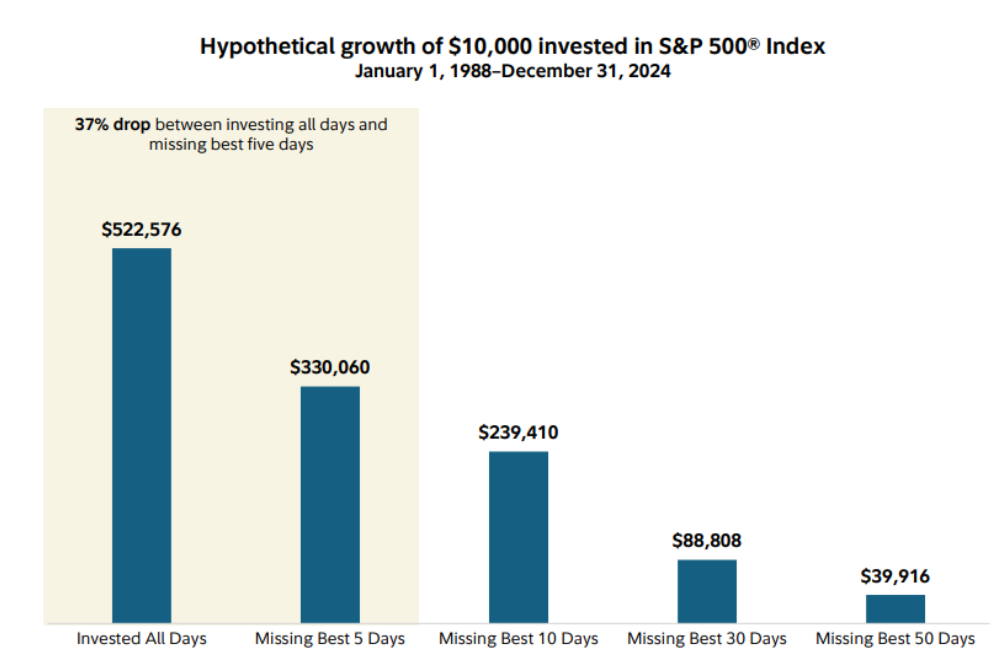
However, history shows that some of the best market days happen right after the worst ones.

As an example, see the chart below highlighting: Staying invested yields a 10.4% gain, while missing the 60 best days results in a -3.7% loss.


When Visibility Is Low, Strategy Matters More Than Ever

Background

The stock market has been volatile the past few days, down about 8.2% from a recent high in early February.

For perspective, the market dropped 8.5% between July 16 and its low on August 5, 2024, but rebounded by August 30, surpassing its July 16 level.

In general, market recoveries tend to be quick. The average time to recovery is three months from a 5%-10% downturn and eight months from a 10%-20% correction, according to Invesco research.


Let’s take a look at two key factors causing the current fluctuations:

#1—Tariffs

President Trump recently imposed new tariffs on Canada, Mexico and China, escalating trade tensions and contributing to market uncertainty. After a 30-day pause, he implemented 25% duties on Canadian and Mexican imports, along with a second round of 10% duties on Chinese goods, bringing total tariffs on China to 20%. (Then, just two days after, Trump issued some exemptions for Mexico and Canada goods. The situation is highly fluid.)

The media often frames this as a “trade war” or even an “act of war,” but we urge you not to get caught up in the rhetoric.


FACTS: Clarifying Misconceptions & Highlighting Opportunity

Tariffs existed well before income taxes in the U.S.

In fact, they were the primary source of federal revenue for much of U.S. history before the income tax was introduced in 1913.

While tariffs continue to generate revenue today, they’re a very small portion of the federal budget compared to income taxes. (To learn just how small, read our post: The Economy, Tariffs & Consumer Sentiment.)

This historical perspective can help put recent tariff activity in context, i.e., rather than viewing them as unprecedented or catastrophic, it’s helpful to remember that tariffs have long been an economic policy tool.

Tariff activity may cause short-term market fluctuations. However, it’s not inherently a signal of economic collapse—despite media hype.

Finally, past volatility—whatever the cause (e.g., inflation, pandemic, tariffs, war, etc.)—has been an opportunity to buy great companies at a discount.


#2—Broad Economic Uncertainty

There’s a general sense of economic uncertainty driven by multiple factors, including geopolitical tensions, inflation concerns, interest rate policies and the new administration’s actions.

In just the last few weeks, Trump has signed nearly 100 executive orders targeting key areas, e.g., immigration, energy, federal workforce policies, trade, etc.

This activity and uncertainty fuels market fluctuations as investors react to shifting economic conditions. Markets tend to be sensitive to uncertainty, and volatility often follows when investors struggle to predict how these factors will play out.


Our Recommendations

Keeping a long-term perspective can help ease concerns about volatility and uncertainty.

In fact, staying invested through the ups and downs is key to long-term success.

Keep in mind:

-Each day, we rebalance 20 to 30 client portfolios to help maintain diversification and manage volatility. We also ensure your portfolio has the right mix of cash and bonds to navigate market fluctuations. Every decision is tailored to your unique risk tolerance and retirement timeline.

-Market swings often present opportunities, and have historically been an opportunity to buy good companies on sale.


Maintain Your Long-Term Financial Plan (Chart)

As we mentioned earlier, it’s natural to feel the urge to move to cash when markets drop. But doing so could mean missing out on some of the best market rebounds.

Consider these market facts from the below chart covering 1/3/05-12/31/24:

  • Seven of the 10 best days occurred within two weeks of the 10 worst days.
  • Six of the seven best days happened right after the worst days.
  • The second-worst day of 2020 (March 12) was immediately followed by the second-best day of the year.


Market downturns are often followed by strong recoveries. Staying invested helps ensure you don’t miss those critical days.

Of course, no one knows the future—but history offers a clear lesson.

Reach out with any questions.

–David Bunker, Financial Advisor & Licensed Fiduciary


Before You Go

Get help optimizing your retirement income. Download our FREE “Prolonging Retirement Income” checklist.

Also, receive help retiring to the life you want, schedule a complimentary financial planning consultation.


This communication was prepared with financial writer Sharron Senter’s assistance, based on interviews with David Bunker, a financial advisor and licensed fiduciary.


Filed Under: Investing Philosophy, Stock Market, Windsor Insights

Capitalizing on Market Peaks, Investing in High Markets

September 23, 2024 by David Bunker

As of 9/4/24, the S&P 500 has hit 33 new all-time highs this year, which may leave some wondering if it’s too late to invest.

While the market may seem overvalued, historical data tells a different story…

Consider this chart showing the S&P 500’s rising highs over time:


While the chart reflects periods of volatility and temporary downturns, the long-term trend is characterized by a series of higher highs.

Recent upward trends have been fueled by economic growth, technological advancements—especially in AI—rising corporate profits and strong consumer spending.

Remember, if we wait for the market to decline before investing, we’d be engaging in market timing, which we avoid since it’s nearly impossible to consistently predict short-term market movements.

Related: Understand the stock market’s seasonality, read last month’s client letter: Stock Market Seasonality and the September Effect.


Before You Go

Get help optimizing your retirement income. Download our FREE “Prolonging Retirement Income” checklist.

Also, receive help retiring to the life you want, schedule a complimentary financial planning consultation.


Filed Under: Investing Philosophy, Stock Market, Windsor Insights, Windsor Money Minute

Q2 Stock Market Results, Job Creation Cooling, Rate Cut Likely

August 14, 2024 by David Bunker

It’s hard to believe it’s already August.

Where does the time go?!

We hope you’re enjoying a healthy and relaxing summer.


Acadia National Park
Photo by Peregrine Photography

Today, we’re discussing:

– Last quarter’s stock market results.

– Factors driving market movements.

– Noticeable slowdown in new jobs.

– Reasons for the early August market correction.

– Potential September interest rate cut.

– Changes we’re making to your portfolio.


Q2 Stock Market Results

The market performed well last quarter.

From January through June, it saw an overall increase of about 15%, with Q2 contributing 4.25% of this growth.

The Magnificent 7 (Apple, Microsoft, Amazon, Nvidia (computer component manufacturer), Tesla, Alphabet (Google) and Meta (Facebook/Instagram/Threads) continue to drive the market’s growth.

However, in the past several days the tech giants are down roughly 20% compared to the overall market.

Why?

Because they’re overvalued.

The other 493 stocks in the S&P 500 are generally performing well. While they haven’t seen the 100%+ gains like the Magnificent 7, their steady performance is a positive sign, reinforcing the benefits of diversification.


Recent Development

A new trend we’re seeing is the sell-off of tech stocks.

Investors are rebalancing by taking profits from these stocks and shifting their investments to more stable, dividend-producing stocks.


Berkshire Hathaway Sold 50% of Its Apple Shares

Speaking of selling tech stocks, Warren Buffett, chairman and CEO of Berkshire Hathaway, supported the sale of roughly 50% of the firm’s Apple stake since the start of the year. Keep in mind, the firm still owns about 400 million shares of Apple stock!

What’s driving the tech selling?

A few things are likely: economic caution, profit taking and maneuvers spurred by the recent jobs report.


July 2024 Jobs Report

According to the Bureau of Labor Statistics (BLS), the U.S. economy added 114,000 jobs in July, a noticeable slowdown from June’s 206,000 jobs.

The unemployment rate also rose to 4.3% in July from 4.1% in June.


Unemployment Rates at a Glance (Last 20 Years)

Job Creation Is Cooling Unemployment Trends
Explore more unemployment factors here, including unemployment by age and education.

Another Interesting Fact From the BLS Jobs Report:

The number of people employed part time for economic reasons rose by 346,000 to 4.6 million in July.

These individuals, who would have preferred full-time employment, were working part time because their hours had been reduced or they were unable to find full-time jobs.

Suffice it to say, the labor market is cooling some. Also, much of the recent job creation is government and health care jobs.


Early August Stock Market Activity

August started with a market correction.

Interestingly, 94% of years have a decline of 5% or worse (see chart). Said differently, the U.S. stock market experiences a correction almost every year.

By definition, a market drop of 10% is considered a correction, while a drop of 20% signals a bear market, the latter occurring about every four years.

Even with the correction, we’re still up about 13% on the year.

Remember, the stock market dislikes uncertainty—the jobs report, upcoming elections, recession rumors and geopolitical turmoil (Iran-Israel tensions) often cause market movements in every direction.


Will the Fed Cut Interest Rates This September?

It’s likely they will, as well as in November and December. Given the recent jobs report and signs of economic slowing, there’s increasing pressure on the Fed to cut rates.

Keep in mind, the Fed’s focus is managing inflation and maintaining full employment. In general, they’re not supposed to care about the stock market.


Your Portfolio

We’re focused on balancing portfolios.

Recently, portfolios have become overweighted in tech stocks due to the sector’s rapid growth over the past few months.

It’s time to take some profits.

After extensive financial modeling, we’re also pulling out of the Vanguard Health Index (VHT). While it’s been one of our favorite investments, it’s now causing health care to be overweighted in portfolios as other funds have added more health care stocks to their mix.


Before You Go

Get help optimizing your retirement income. Download our FREE “Prolonging Retirement Income” checklist.

Also, receive help retiring to the life you want, schedule a complimentary financial planning consultation.

Filed Under: Financial Planning, Investing Philosophy, Stock Market, Windsor Insights

3 Steps To Help Your Money Outlive—You

July 16, 2024 by David Bunker

Today, we help you understand how to make your money outlive you.

The topic of “outliving your money” arises often.


To help ensure your money outlives you, understand these three concepts:

#1—Understand the 4% Withdrawal Rule

#2—Include Retirement “Smile” Spending Changes

#3—Apply Sophisticated Financial Modeling Guardrails

Let’s look at each step in detail and dispel a popular retirement money myth.


Step #1—Understand the 4% Withdrawal Rule

The 4% retirement income withdrawal rule has been used for decades by many investors and financial advisors.

It’s a general rule-of-thumb to help ensure you don’t overspend and, therefore, run out of money during retirement.

Specifically, 4% is considered a sustainable annual withdrawal rate that maintains your savings throughout retirement.

It’s a helpful benchmark.

However, it often doesn’t include all income forms (e.g., apartment rental, Social Security, pension, etc.), or life events (e.g., divorce and helping adult children financially).


4% Rule in Action: Married Couple Example

The below chart depicts a married couple beginning retirement with $2 million in savings, and after applying the 4% rule, having roughly $2.6 million in savings 30 years later.1

That’s right, they end up with more money than they started with.

This example accounts annually for: 2.5% inflation, 6% portfolio growth and 4% income withdrawal, with the couple starting retirement on January 1 and withdrawing $80,000 for the year.


4% withdrawal rule chart
1This is a hypothetical example, simplified for illustration purposes. The ending values do not reflect taxes, investment costs or expenses.

Generally speaking, when you use the annual 4% sustainable withdrawal rate, you likely won’t run out of money in retirement.

Deep Dive: See Fidelity’s comprehensive explanation of the 4% withdrawal rule.


Step #2—Include the Retirement “Smile” Spending Changes

In reality, most retirees spend similar to the retirement smile.

Specifically, spending is higher in initial retirement years, dips during middle years and then increases again in later years.

Simple Example:

Many retirees spend extra on travel during early retirement. Then as you age travel drops off, while health care spending grows.

Up, down, up = smile.

Retirement Smile Spending Chart
Retirement Smile
Image created using Microsoft’s AI image creator.

Continuing the 4% rule example above, the couple would withdraw at least $80,000 from savings each year to cover their expenses.

However, this number isn’t always reflective of reality.

Some years the couple’s withdrawal rate may need to be higher, perhaps $120,000.

Why?

Because hot water heaters break, pool liners tear, vehicles become unreliable and adult children sometimes ask for loans.

We can budget (links to/downloads our budgeting worksheet) till we’re blue in the face and we should! But, life happens.

Therefore, to help make your retirement savings last, consider how spending changes throughout retirement.


Step #3—Apply Sophisticated Financial Modeling Guardrails

There’s a popular myth about retirement.

Specifically, many retirees believe stock market performance could cause them to run out of money.

This isn’t likely true.

Instead, your greatest financial risk is generally longevity risk.

Stock market risk can be greatly reduced by how your portfolio is constructed.

For Example:

The market generally falls about 14% in a given year and bounces back, and one out of five years it typically drops up to 30% for a period.

We help protect you from these fluctuations during retirement by putting about two-to-three years of money aside (cash-like investments still earning interest), so you’re not selling during a down market to fund living expenses.

Managing longevity risk, however, requires sophisticated financial modeling to help reduce the possibility of running out of money in retirement.


Our team uses several financial modeling programs to help you understand what you can spend each year during retirement without running out of money.

One key feature is the ability to apply “guardrails” that show how your money performs during both up and down years.

Ultimately, we stress test your money by applying different scenarios, e.g., retiring during the 2007 financial crisis.

The goal is to keep your spending within the guardrails. Ultimately, your annual “paycheck” may fluctuate some year to year.


Here’s one program in action, using the couple’s $2 million:

The following graph depicts upper (green) and lower (red) guardrails with the couple’s portfolio balance in blue.

Each vertical line shows an intersection whereby the couple can withdraw more than their annual $80,000.

How are the guardrails set?

Our goal is to keep you from hitting the red guardrail.

Therefore, when establishing your unique guardrails we consider your age, goals, health, risk tolerance and how much money you have, while also putting aside a couple years of spending so we don’t have to invade the portfolio during market down years.

In general, we construct your portfolio to stay in between the market’s highs and lows.

We also use historical data to drive the highs and lows. (It goes without saying we don’t know what the future holds.)


Your Money Outliving You Using Financial Modeling Guardrails
Modeling Program: Income Lab

As you can see, there’s a lot going on here, including establishing guardrails and spending limits based on unknown longevity.

Reach out anytime to discuss. We’re happy to show you various retirement withdrawal scenarios using your unique guardrails.


Before You Go

Get help optimizing your retirement income. Download our FREE “Prolonging Retirement Income” checklist.

Also, receive help retiring to the life you want, schedule a complimentary financial planning consultation.


Filed Under: Financial Planning, Investing Philosophy, Windsor Insights

Rising Prices: try these saving tips to free up cash

March 31, 2024 by David Bunker

In the past few weeks, several clients have asked, “Will prices ever come down?”

Short answer—yes and no.

Read on to understand the current pricing situation and gain useful saving tips.

Please share any tips you have for reducing household and lifestyle expenses. We’d love to hear about them. Big or small, all ideas are welcome!


Grocery prices continue upward. Time to get creative!


Today, we talk about:

-Increasing construction and grocery costs.

-Offer key grocery saving tips to combat what seems like non-stop price increases.

-How our investment management approach helps offset economic challenges.


Pricing Overview

Current pricing levels on goods and services are mixed.

For example, prices are down for gas, used cars, airline tickets, furniture and major appliances. However, construction and food prices continue to be up.

Why?


Construction Prices

Construction price increases are largely due to geopolitical turmoil, inflation, regulatory change; and resource and labor shortages, according to a Currie & Brown report.

Also, “Material prices have started to dip slightly as supply chains focus on recovery, but costs remain high compared to pre-pandemic levels,” according to home builder Schar Construction. “Demand for construction will probably keep those costs elevated throughout 2024 and 2025…By 2024, prices could be 25% to 28% higher than they would’ve been compared to pre-2020.”

More than one in five construction workers is aged 55 and up. As these workers retire, the labor pool is expected to shrink even more, according to the CBRE Construction Cost Index. Ultimately, adding to price increases.


Related: See last month’s client letter for a look at the current housing market.


Grocery Prices (up, up and away)

It’s true, you’re spending more money at the grocery store and coming home with less food. In general, food prices are roughly 30% higher than four years ago.1

On a positive note, food price growth has slowed.

So, what’s going on!?

Candidly, food manufacturers are taking profits.

Keep in mind, most grocery categories are dominated by just a handful of companies that own hordes of brands.

For Example:

PepsiCo—owns 23 brands, including Aquafina, Doritos, Fritos, Gatorade, Lay’s, Pepsi and Quaker Oats.

Nestle—owns 2000 brands (not a typo), including Carnation, Cheerios, Lean Cuisine, Starbucks and Stouffer’s.

Kraft Heinz—owns 200 brands, including Maxwell House, Nabisco, Oreo, Oscar Mayer, Philadelphia and Trident.


Here’s just one example of dominating a food category, and increasing food prices without consumers receiving more value:

According to a recent Forbes article, Kraft Heinz dominates the packaged cheese category at 65% market share. Category unit volumes are up just 6%, while prices are up 21%. That’s exactly the intention. “We are not going to be chasing volume,” according to the Kraft Heinz CEO, “We’re going to be looking to drive profitable volume.”

To understand what other companies are dominating the grocery store shelves, read the full Forbes article, Why Your Groceries Are Still So Expensive1.

Related: See our past client letter, Grocery Prices Truths.


Free Up Cash: Try These Creative Grocery Shopping Saving Tips


To save on your grocery bill, do the following:

Beware of end cap “sales”. Just because items are displayed on end caps, doesn’t necessarily mean they’re on sale. Companies pay premium fees to secure these spots, however, if you go further down the aisle, you may find there’s another soup or chip brand priced—even lower. Often, the items on end caps are made to look like they’re on sale, when they’re not.

Buy generic store brands. However, pay close attention to the unit price (the cost of an item by its size) versus the retail price when comparing two similar products. Only then, will you know which product is cheaper.

Note: If you’re purchasing items in bulk at stores like Costco, remember to compare the unit price to what you’d pay at Market Basket or similar stores. Bulk purchases aren’t always the most cost-effective option.

Eat before you shop. When you have a full stomach, you’ll be more likely to resist temptations.

Look up and down. When shopping the middle aisles, stick to items on the top and bottom shelves, they’re typically cheaper. The packaging doesn’t always look as attractive, which is why it’s likely cheaper. When in doubt, compare unit prices.

Plan ahead by making a shopping list. Organize your meals, check your fridge and pantry for ingredients, review sales flyers and use coupons. Stick to your list and only purchase non-listed items if they are staple items on sale.

Swap ingredients. According to Oxford University research, adopting a vegan, vegetarian or flexitarian diet could slash your food bill by up to one-third!

Try shopping at Aldi’s. It’s currently #1 out of the seven cheapest grocery stores in the U.S., according to U.S. News & World Report. Market Basket and Costco are ranked five and seven respectfully. Aldi’s has 21 locations in Massachusetts and nine in New Hampshire.


Free Up Even More Cash

Try These Additional Saving Tips…


Maximize recurring bills, e.g., cable/internet, gym membership, insurance, mobile phone, streaming services, etc.

Are you using everything you’re paying for? If not, cancel or reduce your services. Remember, you can always re-up if you don’t like the change.

Reduce taxes by planning ahead. We’re in the throes of the 2023 tax season deadlines, an ideal time to speak with your accountant and us about ways to reduce your taxes for tax year 2024.

Use a cash back credit card. Fidelity (our long-time financial custodian partner) offers a credit card with up to 2% cash back on everyday spending. This is cash that can go back into your Fidelity account every month.

Also, some clients have their cash back automatically deposited into their kids’ 529 plans or IRA accounts.


Your Investment Portfolio & Offsetting Economic Challenges


Amid rising prices, we’re here to help ensure your financial portfolio is positioned to grow and counter inflation.

How?

We believe equities are the long-term growth engine of a portfolio that helps mitigate the longevity risk that most people face. This said, we use both passive and active strategies to get specific sector exposure, control taxes and manage fund expenses (aiming for an expense ratio below the average of its peer group).

Also, we strive to be as tax efficient as possible to increase long-term returns and reduce clients’ taxes, and are committed to keeping our advisory fees competitive, about 22% below industry average.

With discipline and patience, the market has proven time and time again, that long-term compounding is the key driver of building wealth.

Our primary role is proactively managing this process for you, so you can be off living your life to its fullest.

Read our one-page Statement of Core Investment Beliefs.


Before You Go

Get help optimizing your retirement income. Download our FREE “Prolonging Retirement Income” checklist.

Also, receive help retiring to the life you want, schedule a complimentary financial planning consultation.


Filed Under: Investing Philosophy, Windsor Insights Tagged With: Financial Planning, Grocery Saving Tips

Footer

Amplify Your Retirement Income

"Prolonging Retirement Income" Checklist
Please enable JavaScript in your browser to complete this form.
Name *
Loading

Windsor Insights

A Key Trend Worth Watching & Your Portfolio

There’s been no shortage of noise lately about an “AI bubble.” Yet, the data suggests we’re seeing a structural shift in how the economy … [Read More...] about A Key Trend Worth Watching & Your Portfolio

More Posts from this Category

  • Home
  • About
  • Testimonials
  • Contact

Windsor Wealth Management, LLC · 27 Main Street · Topsfield, MA 01983 · (978)887-6940 · WindsorWM.com · Email Us

Investment Advisory Services offered through Bay Colony Advisors, an SEC Registered Investment Advisor

Disclosure
Form ADV Part 2A – Disclosure Brochure
Form ADV Part 3: Relationship Summary Bay Colony Advisory Group, Inc.

Copyright © 2026 · Website Design · Admin

Copy written by financial services writer Sharron Senter